 comparison
Melton Design Build Alternatives in Colorado: What to Compare
Last Updated: November 5, 2026
Quick Summary
To find Melton Design Build alternatives in Colorado, compare firms on project model, licensing, cost structure, timeline, warranty, and local basement experience. Prioritize design-build firms with in-house designers and verifiable finished basements in your county, and confirm license, insurance, and contract terms in writing before signing.
- Design-build puts design and construction under one contract with a single point of accountability.
- Ask each firm what percentage of annual revenue comes from basement and below-grade work.
- Request references for two finished basements in your county completed in the last eighteen months.
- Compare shortlisted firms on contract price, allowance total, change order method, schedule weeks, and warranty years.
- A large deposit requested before any work begins is the most common contract red flag in basement work.
Table of Contents
- How to Compare Melton Design Build Alternatives in Colorado
- Design-Build vs. General Contractor: Which Model Fits Your Basement Project
- Alternative Firms by Location and Project Type
- Questions to Ask a Basement Contractor Before You Sign
- Basement Remodeling Contract Checklist: Licensing, Insurance, and Warranties
- Basement Finishing Project Timeline: What to Expect Week by Week
- Get a Basement Renovation Quote from Basements.com
- Frequently Asked Questions
How to Compare Melton Design Build Alternatives in Colorado
Searching for Melton Design Build alternatives in Colorado usually starts the same way: you have an unfinished basement, a budget, and a nagging sense that the biggest name in the room isn't automatically the right fit.

Design-build is a project delivery model where one company handles both architectural design and construction under a single contract. That matters for a basement because design and build decisions collide constantly: ceiling height, egress windows, mechanical chases, moisture control.
Here's a comparison framework for hiring a basement contractor:
| What to Compare | Why It Matters | What Good Looks Like |
|---|---|---|
| Project model | Design-build vs. architect + GC | One contract, one point of accountability |
| Licensing and insurance | Protects you if something goes wrong | Verifiable state certification, current COI |
| Cost structure | Determines how change orders get priced | Fixed bid with written allowance schedule |
| Timeline | Basements stall on permit and inspection gaps | Week-by-week schedule in the contract |
| Warranty | Covers workmanship after final payment | Written, transferable, specific term |
| Local project fit | Basement work differs from main-floor work | Finished basement examples in your area |
Design-Build vs. General Contractor: Which Model Fits Your Basement Project
The short answer: design-build fits most basement projects, while the separate architect-and-contractor route fits unusual structural work or owners who already hold detailed plans.
With the traditional route, you hire an architect, get drawings, then bid the work to general contractors.
Design-build compresses that. Design and construction are handled under one contract, so one party coordinates both sides of the project.
- Choose design-build if: you want one point of responsibility, your basement needs layout changes, or you don't want to manage two contracts.
- Choose architect + GC if: you already have stamped drawings or the project involves significant structural engineering.
- Watch out: a "design-build" firm that subcontracts all design work to an outside architect is really the traditional model with better marketing. Ask who employs the designer.
Alternative Firms by Location and Project Type
Colorado's Front Range has many remodeling contractors, and the right pick depends on where you are and what you're building. A Boulder County homeowner with a 1920s bungalow faces different constraints than a family in a newer Castle Rock subdivision. This section gives you a screening method, then shows how to apply it.
Step 1: Sort by project type before you sort by name
A company that builds whole custom homes may treat a basement finish as a small job squeezed between larger builds. A firm that specializes in below-grade space already knows the moisture, egress, and ceiling-height problems you're about to inherit. Ask each firm what percentage of its annual revenue comes from basement and below-grade work.
- Basement finish or remodel: prioritize firms with finished basement examples in your county and a dedicated below-grade crew.
- Basement plus structural work (beam removal, walkout conversion, underpinning): prioritize firms that employ or retain a structural engineer rather than subcontracting engineering cold.
- Whole-home or custom build with a basement component: prioritize design-build firms with in-house architecture, because the basement decisions get made alongside the rest of the house.
Step 2: Apply location as a filter, not a ranking
Service area matters for two concrete reasons: permit familiarity and crew travel time. A firm that pulls permits weekly in one jurisdiction knows the plan reviewers and common comment letters; a firm driving two hours each way will lose days to travel and may rotate crews. Ask for the firm's physical office address and which jurisdictions it has pulled basement permits in during the last twelve months.
Step 3: Build a shortlist using public records, not review stars
Local review profiles are a reasonable starting point, but ratings and review counts don't verify basement experience, service area, or pricing.
Here is the screening sequence that separates a lead from a candidate:
- Verify the license. Look up the firm's state license or certification number in the public licensing database and confirm it is active and held by the entity you're contracting with, not an individual who may not be on your job.
- Verify insurance. Request a certificate of insurance naming general liability limits and confirming workers' compensation coverage. Call the insurer to confirm the policy is current.
- Verify local outcomes. Ask for addresses or references for two finished basements in your county completed in the last eighteen months. A contractor who can't produce a similar finished basement nearby is asking you to fund their learning curve.
- Verify the contract structure. Ask whether the firm offers a fixed bid with a written allowance schedule or bills time and materials. Both can be fair; only one lets you compare bids apples to apples.
- Verify who employs the designer. A "design-build" firm that subcontracts all design work to an outside architect is really the traditional model with better marketing.
Step 4: Compare the shortlist on the same five numbers
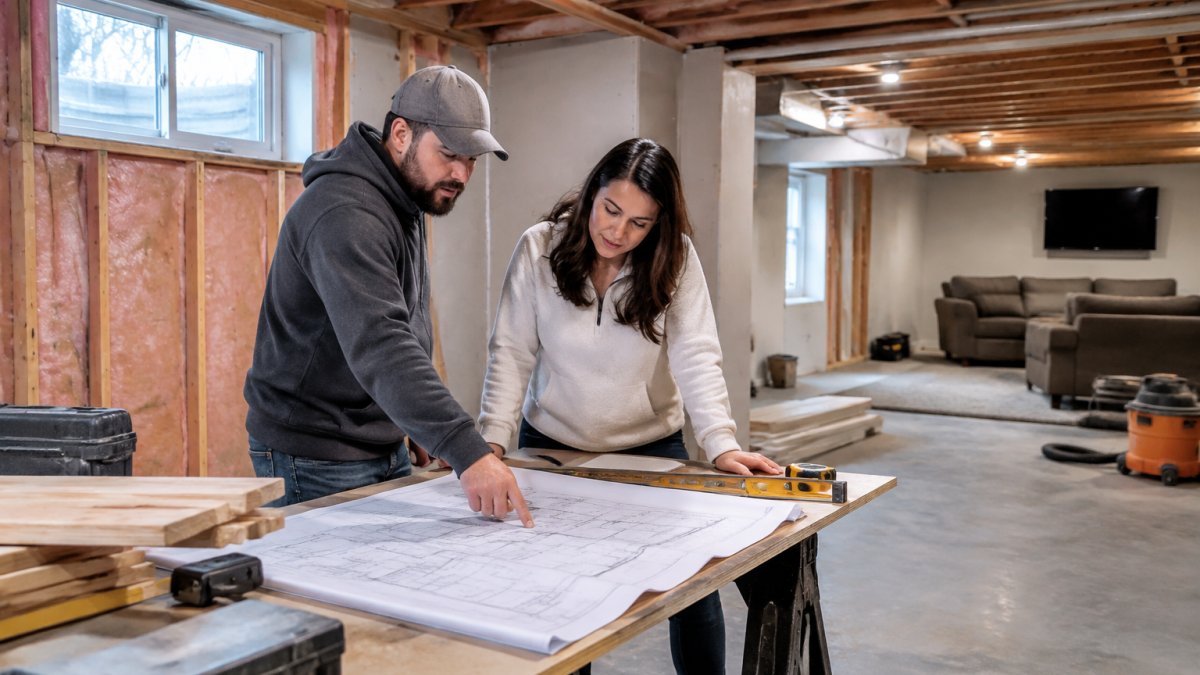
Once you have three candidates, put their proposals side by side and compare the same five figures: total contract price, allowance total, change order pricing method, schedule duration in weeks, and warranty term in years. For local cost benchmarks to judge whether each firm's pricing is reasonable, see this guide to basement renovation cost in Northern Colorado. Firms that won't put those five numbers in writing are worth questioning.
The man is American.
Watch out: a firm that ranks well on review sites but cannot name a single finished basement in your county is a marketing operation first and a builder second.
Questions to Ask a Basement Contractor Before You Sign
Ask these questions in the first meeting, and listen for specifics rather than reassurances.
- Who pulls the permits, and who handles inspections? In most Colorado jurisdictions the licensed contractor pulls permits. If they ask you to pull your own, that's a red flag.
- How do you handle egress windows for a future bedroom? Egress requirements are set by building code and enforced locally. A firm that finishes basements regularly should answer this without checking.
- What's your change order process? Ask for the written form and who signs it. Vague answers here are how budgets get destroyed.
- Who is on site day to day? Find out whether you get a dedicated project manager or a rotating cast of subcontractors.
- What does your warranty cover, and for how long? Get it in writing before you compare bids.
- Can you show me a finished basement within 20 minutes of my house?
If you want to see how a licensed local contractor answers licensing and process questions before you start calling around, the frequently asked questions page covers the basics.
Basement Remodeling Contract Checklist: Licensing, Insurance, and Warranties
A basement remodeling contract should name the license holder, attach current insurance certificates, specify the warranty term, and lock the payment schedule to completed milestones. If any of those four items is missing, don't sign. The checklist below is the one to bring to the signing meeting.
The checklist
- Contractor's state license or certification number written into the contract, matching the entity name on the signature block
- Certificate of insurance for general liability, with your address listed as an additional insured for the project
- Workers' compensation coverage confirmed for anyone entering your home, including subcontractors
- Warranty terms in writing: workmanship, materials, and duration, with a named contact for claims
Why each line matters
Insurance and additional insured status. General liability protects the contractor; additional insured status protects you if a claim arises from the work.
Warranty term and claims process. A one-year workmanship warranty is common; longer terms exist but usually carve out materials and wear items.
Allowances. Allowances are where budgets quietly grow. A $5,000 flooring allowance sounds generous until you price the tile you actually want.
Permits and resubmittals. In most jurisdictions the licensed contractor pulls permits.
The moisture clause
If your basement has shown dampness, ask how the contract handles it. Remediation discovered mid-project is one of the most common sources of cost overrun, and a contract that doesn't address it leaves the risk with you. The cleanest approach is a pre-construction moisture assessment with a written contingency amount and a defined scope for what triggers it.
What to do when a line is missing
Don't negotiate verbally. Send a short email listing the missing items and ask for a revised contract. A contractor who resists putting license, insurance, warranty, and lien waiver terms in writing is telling you how the project will go. The firms worth hiring will treat the request as normal.
Basement Finishing Project Timeline: What to Expect Week by Week
The length of a basement finish depends on scope, permit timelines, and how much framing and mechanical work the space needs.
| Phase | What Happens | What You Should See |
|---|---|---|
| Design and permitting | Drawings finalized, permits submitted | Approved plan set |
| Demolition and prep | Old finishes removed, site protected | Clean, ready shell |
| Framing and rough-in | Walls framed, electrical and plumbing roughed | Inspection sign-off |
| Insulation and drywall | Insulation set, drywall hung and finished | Smooth walls |
| Finishes | Flooring, trim, paint, fixtures | Rooms taking shape |
| Final inspection and punch list | Code inspection, corrections | Certificate and walkthrough |
Permit review is the least predictable phase.
Change orders are the other timeline killer. Every approved change adds design time, ordering time, and often inspection time.
For a deeper look at how phases and change orders interact, read our breakdown of the basement remodel timeline and change orders.
Get a Basement Renovation Quote from Basements.com
Comparing firms is the right work, and it gets easier once you have a real number to compare against. At Basements.com, we are a Colorado State Certified and fully insured general contractor with over 25 years of experience.
You can use our online pricing estimator to get a ballpark cost for your project with layouts and finish levels, or request a free estimate with no obligation.
Frequently Asked Questions
What are the best alternatives to Melton Design Build for a basement project?
The best alternative depends on your project scope and how much design help you need. Look for Colorado-licensed contractors who carry general liability and workers' compensation insurance, have verifiable local project portfolios, and offer transparent pricing models. Basements.com brings 25+ years of experience as a Colorado State Certified general contractor, with full-service project management from design to final inspection, which suits homeowners who want one team handling design and construction.
How do I compare design-build contractors for basement remodeling?
Compare them on four points: licensing and insurance, pricing structure, project timeline, and portfolio fit. Ask each firm for a sample contract and a written scope of work. Design-build firms handle architecture, design, and construction under one contract, which can reduce coordination delays. Basements.com offers full-service project management with guaranteed code compliance, so you can compare its scope against other Colorado contractors.
What should a basement remodeling contract checklist include?
A solid basement remodeling contract checklist should cover: scope of work with specific materials and dimensions, project timeline with milestones, payment schedule tied to progress, change-order procedures, warranty terms, and proof of licensing and insurance. In Colorado, confirm the contractor's state certification and ask for a certificate of insurance before signing. Basements.com offers guaranteed code compliance as part of its full-service management.
How long does a basement finishing project usually take?
The length of a basement finishing project depends on square footage, structural changes, and permit timelines. Basements.com offers full-service project management from design through final inspection.
The hardest part of this process isn't finding contractors. It's knowing which questions to ask before you sign. Get a written number from a licensed, insured team that has finished basements in your area, and compare it against the framework above. Get started with Basements.com and turn your unfinished space into a finished, code-compliant room.